Runtime Enforcement_

Endura turns pipeline behavior into kernel-enforced policy, stopping unauthorized actions before they become breaches.
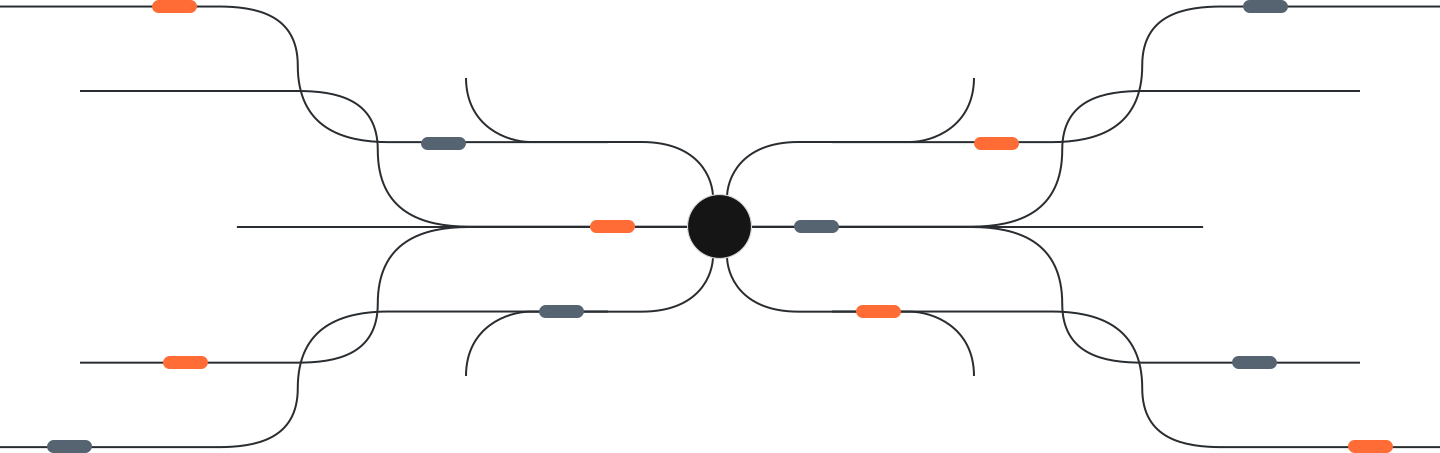





See every pipeline, understand every build, and enforce consistent security controls wherever your software runs.


Every Pipeline, Monitored
See every CI/CD pipeline and build in one place.

Every Behavior, Captured
Understand what every build actually needs.

Every Action, Governed
Apply mandatory access controls while builds run.

Every Violation, Actionable
Stop malicious behavior before they cause damage.
Every Pipeline, Monitored
See every CI/CD pipeline and build in one place.
Every Behavior, Captured
Understand what every build actually needs.
Every Action, Governed
Apply mandatory access controls while builds run.

Every Violation, Actionable
Stop malicious behavior before it causes damage.
Bring your CI/CD estate into one unified view with Team Server. See every pipeline across providers, teams, and environments, and know what needs to be protected.
Unified Inventory
CI/CD Integrations
See Your Pipelines

Endura's Runtime Sensor uses eBPF to observe activity from the kernel. See the files, processes, network connections, credentials, and resources each build touches, then turn that behavior into the context needed to define least-privilege policy.

Runtime Context
Runtime Policy
Understand Runtime Sensor




Endura enforces deny-by-default policy in the Linux kernel using eBPF LSM hooks. Unauthorized file, network, process, memory, container, and kernel operations are denied at the source, terminating the offending process before it can continue.
Enforcement Coverage
Real-Time Insights
Policy Reference
Enforce Your First Policy
Runtime Sensor sends violations and runtime context to Team Server, where teams can triage activity, tune policy, route alerts, and coordinate response from one operational view.
Faster threat identification and containment (Source: IBM)
Average reduction in breach costs (Source: IBM)
Respond to Violations

Protect Your First Pipeline with Endura
Connect your CI/CD environment, deploy Runtime Sensor, discover your pipeline in Team Server, and establish the baseline needed to move from visibility to enforcement.

From Runtime Behavior to Enforced Policy
Learn how Endura derives least-privilege policy from real build behavior, validates it without disruption, and moves pipelines safely from observation into kernel-level enforcement.

The Cooldown Illusion: Waiting Isn’t Enforcement
Dependency cooldowns filter some fast-moving attacks, but they still depend on someone else detecting the compromise first. See why controlling behavior at runtime closes the gap.
Protect Your First Pipeline with Endura
Connect your CI/CD environment, deploy Runtime Sensor, discover your pipeline in Team Server, and establish the baseline needed to move from visibility to enforcement.
From Runtime Behavior to Enforced Policy
Learn how Endura derives least-privilege policy from real build behavior, validates it without disruption, and moves pipelines safely from observation into kernel-level enforcement.
The Cooldown Illusion: Waiting Isn’t Enforcement
Dependency cooldowns filter some fast-moving attacks, but they still depend on someone else detecting the compromise first. See why controlling behavior at runtime closes the gap.


FAQs are updated regularly based on real customer feedback.
01
Isn’t this what SCA, SAST, and attestation already do?

No. SCA tells you what’s in your build. SAST finds flaws in code. Attestation proves where software came from. Endura controls what that software is allowed to do when it runs, enforcing runtime boundaries in the kernel before unauthorized actions complete. Endura complements these tools rather than replacing them.
02
Does Endura actually block attacks, or just detect them?
Endura is built for prevention, not just detection. Runtime Sensor uses eBPF Linux Security Module hooks to evaluate security-sensitive operations in the kernel and reject unauthorized actions before they execute. Where eBPF LSM is unavailable, Endura can fall back to monitoring and terminate offending processes after detection.
03
How do I enforce least privilege without breaking my builds?
Start by deriving policy from real pipeline behavior, then validate it in observe mode without blocking anything. Once the policy reflects expected behavior, switch to enforce mode to block anything outside the boundary.
04
Will Endura work with my existing CI/CD and Linux environment?
Endura integrates with GitHub Actions, GitLab CI/CD, Jenkins, Bamboo, and TeamCity, while Runtime Sensor supports major Linux distributions on x86_64 and ARM64. Sensors can be installed natively or deployed with Docker, Podman, and Kubernetes.
05
Can Endura be fully self-hosted?
Yes. Enterprise customers can self-host the complete Endura stack, including Team Server and Runtime Sensors, in infrastructure they control. Team Server supports Docker, Podman, and Kubernetes deployments across on-premises and private-cloud environments, with OIDC authentication and granular role, resource, and policy access controls.

Explore transparent pricing. Start free, scale as you grow. Only pay when you’re ready.
For validating on a focused set of critical pipelines before expanding deployment.
$500
/Pipeline/Year

Up to 25 protected pipelines
Full runtime enforcement
Automated policy generation
Unlimited pipeline discovery
For growing teams ready to protect production pipelines across their CI/CD environment.
$500
/Pipeline/Year
Up to 300 protected pipelines
Everything in Pilot
Notification integrations
Multi-provider CI/CD coverage
For organizations standardizing across environments and operating models.
Custom
Pricing
Enterprise-scale coverage
Everything in Business
Managed or Self-Hosted
Multi-business-unit deployments
For validating on a focused set of critical pipelines before expanding deployment.
$500
/Pipeline/Year
Up to 25 protected pipelines
Full runtime enforcement
Automated policy generation
Unlimited pipeline discovery
For growing teams ready to protect production pipelines across their CI/CD environment.
$500
/Pipeline/Year
Up to 300 protected pipelines
Everything in Pilot
Notification integrations
Multi-provider CI/CD coverage
For security teams standardizing runtime policy across a growing pipeline estate.
Volume
Pricing
Up to 2,500 protected pipelines
Everything in Startup
Graduated volume pricing
Analytics and reporting
For organizations standardizing across environments and operating models.
Custom
Pricing
Enterprise-scale coverage
Everything in Business
Managed or Self-Hosted
Multi-business-unit deployments
Turn pipeline activity into visibility, policy, and action with Endura.

Endura enforces what your pipeline is allowed to do at the kernel level, blocking unauthorized network connections, file access, and process execution as they happen. Let us show you what that looks like on a real build.